> For the complete documentation index, see [llms.txt](https://time-series-features.gitbook.io/research-resources/llms.txt). Markdown versions of documentation pages are available by appending `.md` to page URLs; this page is available as [Markdown](https://time-series-features.gitbook.io/research-resources/advice/communicating-your-research.md).
# Communicating your research
Presenting your work is a key part of being a scientist, and it requires careful thought, preparation, and practice to imagine the audience and take them on a journey from where they are to where you want to get them to.
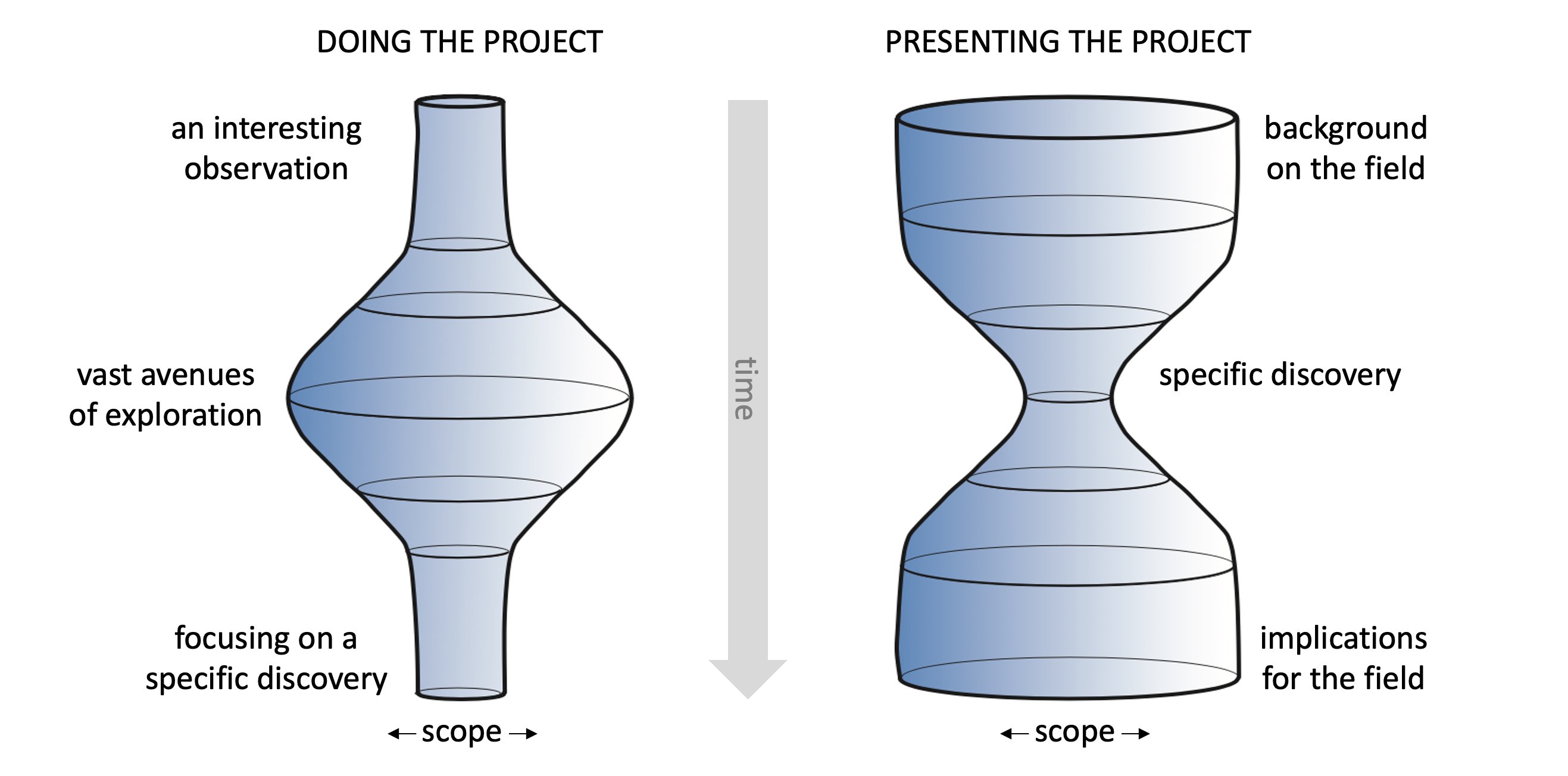
Here is a useful image from [Itai Yanai](https://twitter.com/ItaiYanai) that helps depict a key difference between doing science and communicating science:
## Making posters
[A video](https://youtu.be/1RwJbhkCA58) on how to construct a good poster for a large conference. Includes some great insights into the conference attendee experience.
## Making presentations
* [Keynote](https://www.apple.com/keynote/) is very nice to use, but is only for Mac, and doesn't allow version control.
* [Powerpoint](https://office.live.com/start/powerpoint.aspx), you know it.
* [Deckset](https://www.deckset.com/) is a nice way to make presentations in markdown, but is only for Mac.
* [Marp](https://marp.app) allows markdown-based presentations, enabling very quick slide preparation, easy embedding of code and hyperlinks, and version control.
* If you wanna blow the socks off of your audience, this is a nice tool for making animated plots
---
# Agent Instructions
This documentation is published with GitBook. GitBook is the documentation platform designed so that both humans and AI agents can read, navigate, and reason over technical content effectively. Learn more at gitbook.com.
## Querying This Documentation
If you need additional information that is not directly available in this page, you can query the documentation dynamically by asking a question.
Perform an HTTP GET request on the following URL with the `ask` and `goal` query parameters:
```
GET https://time-series-features.gitbook.io/research-resources/advice/communicating-your-research.md?ask=&goal=
```
`ask` is the immediate question: it should be specific, self-contained, and written in natural language.
`goal` is what the user is ultimately trying to achieve, the reason they need the answer. Sharing it helps GitBook give you a better, more relevant answer. A goal is most helpful when it describes the outcome the user wants rather than restating the question. For example, with `ask=how do I create an API token`, a goal like `build a script that syncs our docs to a CMS` lets GitBook tailor the answer to that use case.
The response will contain a direct answer to the question and relevant excerpts and sources from the documentation.
Use this mechanism when the answer is not explicitly present in the current page, you need clarification or additional context, or you want to retrieve related documentation sections.